This is going to be my final blog post. It is rather lengthy, but it is a overview of all the business information I gained from this trip. All in all, it was a great experience and I was able to travel with a great group of students. I wouldn't have traded any of them for the world, even if we did have our differences at some points. Thank you JJ Shields, and Suzy Shields for instructing and enjoying the trip with us and thank you Bill Belson, Erik Ekholm, Professor Dr. Claes G. Alvstam, Martin Lundh, Bert Thorvaldsson, Hakan Sandberg, Anna-Karin Holmqvist, Andrew Hammond, Anders Classon, Mangus Sjolin, Per Norlin, Camilla Schnabel, and Par Svensson. It was a great learning experience and a journey I will never forget. As the Swedes say, "Ses Senare!" (see you later.). Thank you for taking the time to read my blog, and I hope you enjoyed reading about my journey to Sweden!
Sweden J-Term Trip Overview
Carthage College offers a unique opportunity for students to study a single subject exclusively for one month. The International Business Sweden Trip was a great experience to learn about international business, the Swedish culture, and diversify my knowledge. Traveling abroad has changed the way I think, act, and feel in a way unattainable in the normal classroom environment.
Visiting successful businesses is a great opportunity to connect classroom material to the real world. By visiting Bruno Independent Living Aids, Inc. in the United States and ten businesses in Sweden, we were able to enhance our understanding of marketing, management, finance, personal relations, communication, product development, and manufacturing. It is only with a proper understanding of these core studies that will separate us from the goods in Corporate America to the greats.
The first business on our itinerary was Bruno. Bruno is a global manufacturer of accessibility products designed to enhance the lives of those challenged by limited mobility. By touring the manufacturing facility, we visualized the process of converting raw materials to finished goods. In addition, Bill Belson taught us Bruno's Lean procedures and product optimization strategies.
Product optimization through Lean management is the best way to lower costs and increase profits. Inventory specialists, Bruno engineers, and Gemba sessions brought products from a twenty-eight minute product development time to six minutes by removing all unnecessary production procedures. Lean procedures were implemented to reduce the product travel time, generate new efficient practices from the product line, and reduce product errors. They used the Spaghetti Dragon to track product movement throughout the facility to reduce the travel time, and the Gemba sessions to utilize line workers coupled with management inputs for greater efficiencies within the facility. The visit to Bruno allowed us to tour a manufacturing facility, conceptualize the benefits of product optimization, and understand the importance of employee knowledge.
The second business we visited was Skapa; an agency specialized in creating smart online communication. They focus on online strategies and content marketing for their customers through website technology, website development, and social media. Erik Ekhom taught us the importance of an online presence for any business and the triangle of success of listening, adapting, and learning.
Through numerous Youtube videos, Erik illustrated the difference between the good, the bad, and the great advertisement strategies. He expressed the importance in advertisement to create emotions, engage the audience, and or generate a surprise. It is with those qualities that videos and commercials attract viewers and become viral. In addition, he taught us the importance of headline and description correlation to produce high Google pings.
Erik's presentation on website analysis taught us the importance of producing relevant content to reach out to a specific target audience. One wouldn't want to advertise an expensive luxurious item on the home page of the Wal-Mart website. By understanding one's audience, it is possible to create a personable tone within one's ecosystem, which is far more receptive towards consumers.
In addition, he discusses the importance of managing one's ecosystem. A marketing ecosystem is the viewable content of a business from blogs to advertisements. His biggest challenge comes from individuals who do not believe that a strong online ecosystem is necessary. One concern consistently expressed to Erik is, "If I am not online, then nobody can speak ill against our company or steal our business." Erik then tries to sell the idea that word of mouth is unavoidable, and it is better to have an online presence to counter or explain negative criticism and showcase positive remarks. It is important for business to have an online presence if they wish to be successful.
However, there is more to being successful in this business than just having an online presence. To work in this field, one needs to be a great listener. If the marketer is not attentive to consumers, then he or she won't be able to meet the needs of the customers. One must keep up with consumer trends and be ahead of technological advances. Howbeit, it is difficult to keep up with the ever evolving network that has a turnover rate of six months.
Thus, Skapa taught me the importance of listening, adapting, learning, and creating a platform that builds confidence in you as a person. He illustrated that if you are great at something you do, then it will show and that as a startup business, you have to sell yourself a lot. In addition, he portrayed the importance of customer retention for growth and success and that the first customers of a business are the most important customers. As long as a business focuses on the initial target market, does not get spread too thin, it is possible for any business to attract consumers.
Our next stop was Gotenburg University. Here we were able to learn about the differences in management styles between Sweden, and the United States. The management style in Sweden is more collaborative and follows the Law of Jante. This ideology encapsulates the belief that nobody is better than his or her peer is and that equality is reflected in his or her interactions and business practices. Business executives are modest in their job titles and are even more humble about the quality of their work. However, they are more direct towards performance reports and are not afraid about telling workers when they are underperforming.
In addition, we learned about the functionality of shopping malls. It was interesting learning about the necessity of proper architecture and location. The architecture has to create an adventure for the consumer to attract them to go to the stores versus ordering products online. Some examples of attractions within malls are theme parks, special events, submarine life, and extensive interior design. Even the layout of the stores and the ease of movement within the mall are crucial to the success of the facility.
After learning about having the proper functionality of a business, it was only natural to speak with Martin Lund about product development position at WirelessCar. WirelessCar is an automotive telematics service provider (TSP), providing manufacturers of cars and commercial vehicles with customized telematics services to end-customers anywhere in the world. Through customers like BMW, Volvo Cars, Volvo Trucks, and Volvo Construction Equipment, WirelessCar is striving to create a connected world where an endless stream of data can benefit the end user in everything from accident awareness to efficient shopping experiences. Martin's presentation interactive presentation style immediately grabbed my attention. His slide show was a story that had minimal words and numerous pictures. It was like reading an advanced Dr. Seuss book with a personal narrator. It resulted in a more engaged audience and a classier appeal.
His presentation started off by telling the story and future of WirelessCar and then went into details about the operations of the business. I would have never expected that growth can have negative effects. If a company grows too fast, it could experience growing pains in which it might not be able to sustain the new level of operations. At a management level, foresight is crucial and it is important to understand employee capacity and know when to expand and contract the workforce.
Project management is considered a technical position because of the necessary foresight and diversity of knowledge to conduct daily operations. Project managers must be able to lead a team and hire the right people for the right jobs. A product planning project manager must also have the ability to transition customer demand into provided services. It's like being the spider in the web. One must talk to everybody, have a basic understanding of every specialty within his or her team, and be able to combine the final products from each person. Thus, it is crucial for a project manager to have a proper understanding across multiple disciplines.
To be successful in this position, one must have a willingness to learn. They must have a general knowledge across multiple disciplines and have the ability to learn quickly. They must be able to lead and drive discussions in meetings and must be quick on their feet. These skills will lead to the ability to properly communicate to different target audiences. At a high level, the project manager must be the lawyer, the salesman, the marketer, the financer, and the coder to effectively lead the team.
ABB Robotics with Bertil Thorvaldsson was our next destination. ABB Robotics is a global company in power and automation technologies. They have a range of different products and systems like robots, applications, equipment, software, manufacturing cells, and automotive systems. "Bert" is the Steve Jobs of ABB Robotics. He affirms that Apple was successful because they paid attention to the end-user. They made it easy to use and customer friendly. In addition, he taught us that you must have one person in mind when you are creating a business.
Yet, having a target market is not the only necessity to creating a prosperous business idea. One needs to generate a proper business model. Bert described in great detail the differences between the “Legacy”, “Freemium,” and “App-Store” business models. The Legacy Business Model is when everyone in a business, from the front desk to the front line, is following the same unique formula, business runs like clockwork and success repeats itself. The Freemium business model works by offering simple and basic services for free for the user to try and more advanced or additional features at a premium. The final business model, App-Store business model, is when you supply free apps and pay apps that require consumers to pay per download, periodic payments, or freemium. These three business models can supply target specific companies with the proper business model for success.
As Bert concluded with types of business models, it was a great transition into Hakan Sandberg at AutoAdapt; one of the world’s leading manufacturers of car adaptation solutions for people with reduced or limited mobility. This presentation covered employee benefits in Sweden and general business practices and business model generation at the MBA level.
The presentation started with Hakan saying, “We have to develop the best people.” You can have the best product, but if you have the wrong people, you will fail. They care tremendously about their employees and they put a lot of energy into training people. This is mostly because the entrance and exit procedures are difficult to overcome and it can be ten times the cost to for the retraining process.
To start off, it is hard to get a job in Sweden. Some companies use the STAR (Situation, Task, Action, Result) model to interview candidates. The STAR model is a behavioral interview technique that tries to get at how the interviewee responded to negative situations and to quantify the results. Then, they put the results into a chart and compare which block the interviewee’s response best reflects. One question could have sixteen different answers.
However, it is important for interviewees to be mentally prepared, strive to improve oneself, have strong emotional awareness, and to research the prospective position. In addition, it is imperative that the interviewee have questions ready before the interview.
Another aspect that affects numerous applicants on the job search is the production of template emails. When making first contact with businesses, one should make a more personalized letter that is specific to the company and position of application. That means do not react to seeing an opening, be proactive and do your research.
Once the interview process and competency test have concluded, the job offer and benefits are extended to the new employee. In Sweden, there is no politics or discrimination in the workforce. Though they believe in equality, wages are not all the same, it is one’s competency level that generates one’s value. With strategic planning and mapping, competency analysis, strategic supply of competency and target base of development results in the higher the competency, the higher the salary. A more common reference to the Swedish business practices is a white collar union.
In the life of a Swedish employee, they live in a social democratic government. They pay tremendously high taxes; up to 57% federal income tax and 25% value added taxes. However, unemployment has better benefits in Sweden; about $2,000 a month. In addition, Sweden is huge on proper parenting practices. When employees have children, they are given 15 months of 80% wages compensation to stay home. Those months can be split or divided anyway between the husband and wife, which forces males to have to stay home with children as well. Lastly, the age of retirement in Sweden is 65, in which the company had paid for and now the government supplies.
Another interesting aspect about the employment benefits of Sweden is that it is hard to fire employees. If a manager is going to fire an employee, if they have been working for more than 2 years, they must tell them 1 month in advance. As the employee works for the company longer, the notice is longer. For example, if an employee works for five years, they must give three months notice. This is a much longer notice time than the United States; however, they can still fire on the spot for theft or breaking corporate policy.
“What is your motivation for implementing your idea?” Hakan’s response to creating an employable business is never the money but it might have been because his mother dropped him as a baby. The true answer is he has a mindset to develop and create a more efficient product than the market currently produces. He believes you don’t need to develop new products because it is costly and time consuming to develop a new market. It is more beneficial to take an existing product and make it better.
Step one to creating a new business, talk to the competitors of your business idea. Get a proper understanding on how they operate and what they are doing right and what they are doing wrong. Then, expand on your knowledge and create a better product or service. Next, it is crucial to talk to the consumer and investors with honesty to build trust towards your prospective idea. Explain to them the mission, vision, business idea, strategic intent, financial projections, competitive strategy statement, distribution strategy, customer strategy, brand strategy.
As stated in the Skapa learning experience earlier, the initial customers are the most important. If you leave a sour taste in the initial investor, it will be hard to recover. You must determine the customer value and what special needs they have. Lastly, you have to always be willing to sell yourself, be honest, and have a positive attitude to leave an impression that can last a lifetime.
Then, it is important to make SMART goals (an acronym for the 5 steps of specific, measurable, attainable, relevant, and time-based goals) because it is the most effective tool used by high achievers to reach their goals – realistically and consistently. In addition, make a product flower that is the flow diagram that explains the product breakdown structure. This will give a view of the sequence in which the different products are likely to be delivered. The interdependencies between sub-products and their relative business priority will help drive the diagram.
Though Hakan and Anna-Karin have supplied a vast amount of knowledge thus far, they went a step further to explain, at an MBA level, how to transform a business plan into seven consolidated and concise pages. In this business plan, they stress the importance of cash being king, organic growth, trend setting, and understanding the end-user. Lastly, you need to be passionate and honest and follow the 17 steps to generating a proper business plan.
1. Management must make quick decisions and have consensus between owners and management is crucial
2. Strong owner’s commitment to growth (reinvestment)
3. Strong liquidity, need enough cash to pay suppliers at all times (This must be measured and controlled daily)
4. 30% owner’s equity (Otherwise you are not independent of owner’s working capital)
5. Need to have a heart for growth
6. Source of finance – internal resources for quick growth, which demands capital
a. Be honest when you forecast future earnings
7. Active financing – external financial resources
8. Creating Markets
a. Do not compete with local markets because they can transition to consumers and keep the competition low
b. Be a trend setter – make the competition work for you
9. Product flower
a. When done right, it creates customer loyalty with a visual representation of the product.
10. Product control
a. Control who, where, and when products are produced.
b. In sourcing can be more costly, but can product a better quality
i. Products from China can use supplies and workmanship that is subpar to developed nations
11. Distribution control
a. Demand high quality
12. Internalization
a. Higher volume = higher market share
13. Scare resources
a. Lean production practices
b. Organic growth vs. poach chasing other companies with proper due diligence practices
14. Set goals that challenge you and your business
15. Leadership
a. Symbolic leadership
b. Active delegation
c. Respect for intuitive decisions
d. Using time management tools
e. Always good to have external sources for decisions to have a broadened view of the project
16. Balance of management
a. Need to have all three skills
i. Visionary
ii. Analyst
iii. Integrator
17. Experience of management
a. First business is the hardest to develop (benchmark)
b. Board members need to be business men
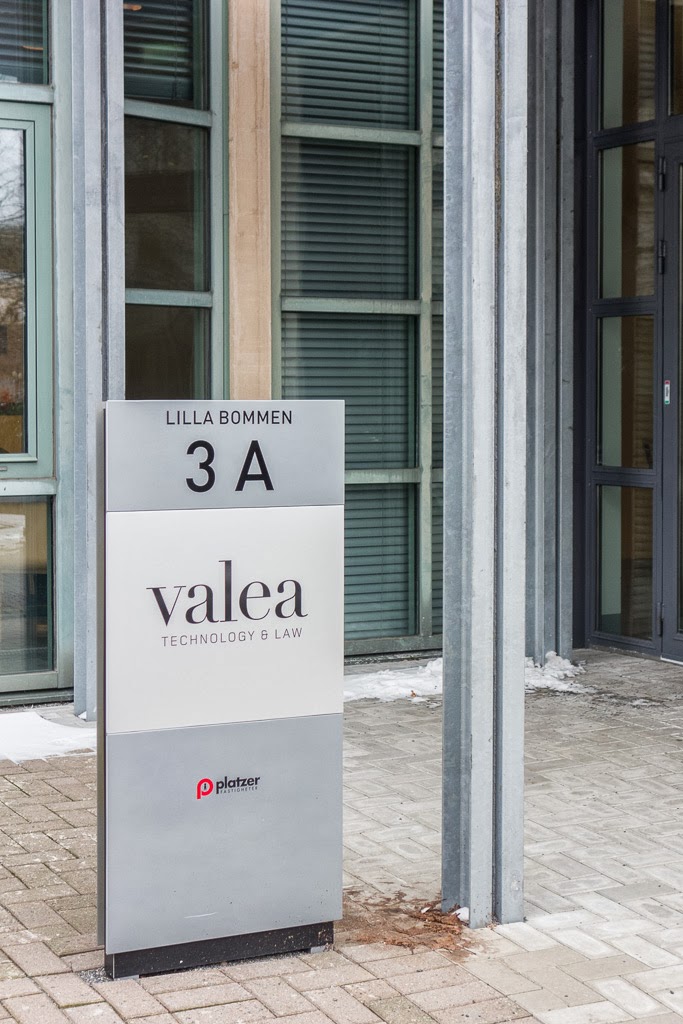
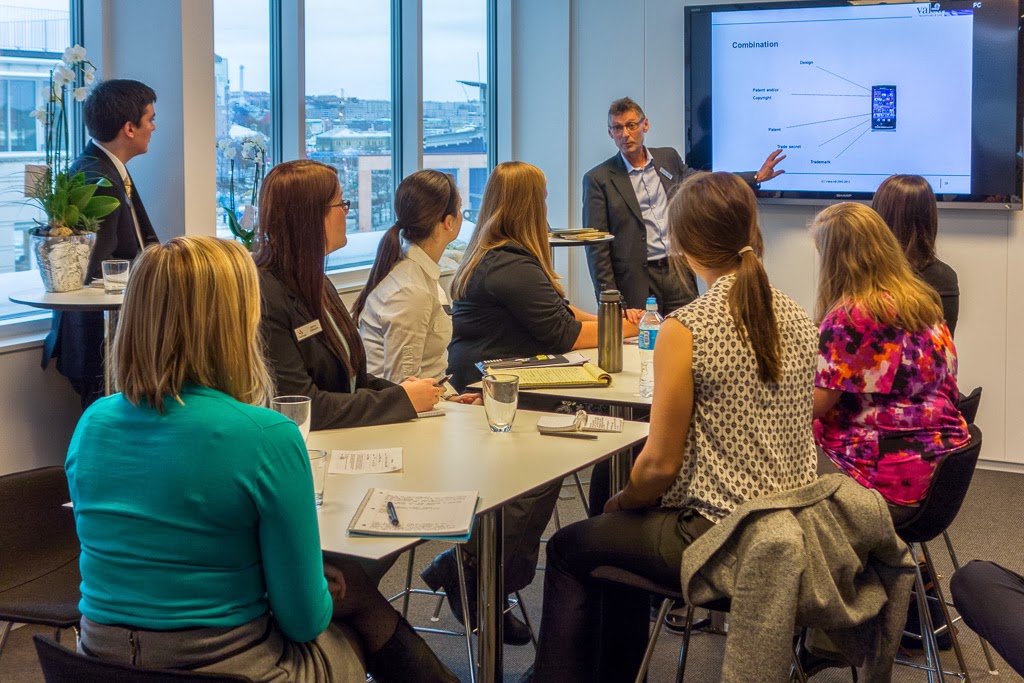
Now that we had learned the proper way of conceptualizing and executing a business model, it is essential that we learn how to protect our intellectual property rights. Our next stop was Valea with Andrew Hammond. Valea AB establishes, defends, and commercializes IP assets such as patents, trademarks, and designs.
For a startup company, Intellectual property rights, IP rights, bring money or power to the initial balance sheet. 80% of most business value is in IP rights and there is a constant fear that the competitors will discover how create your product. That is why it is crucial to hire attorneys to draft legal documents to protect those rights.
As we know, patents stimulate innovation and allow the inventor to have a monopoly over the product. Then, companies like Valea create a proactive and strategic approach to maximize the value of the IP rights. Sometimes, companies will patent a worse product than the initial patented product because they want to own the market and own the alterative products too.
Lastly, we learned the difference between a discovery and an invention. When the cavemen first saw fire, that was not a patentable product, it was a discovery. If we can say that it is a new idea that helps mankind, it is patentable. However, some products that are patentable, which are bad for mankind. For example, dynamite, which was created by Alfred Nobel to save his factories from blowing up, but were later used for destruction and war.
Yet, at some point, patents expire and the profit margins decrease as the product is opened up to the market. That is why patent attorneys focus intensely on industrial design, interface design, and strategic design. They have to be able to transition all the elements of a product into precise words and understand the full functionality of the product. Moreover, as patents expire, they need to make minor adjustments to try to keep the property rights of the product. For example, the drug Precedex produced by Hospira went off patent in 2014 and to maintain some intellectual property rights, they patented the premix solutions that maintained 60% of original sales that otherwise would have been lost to the market.
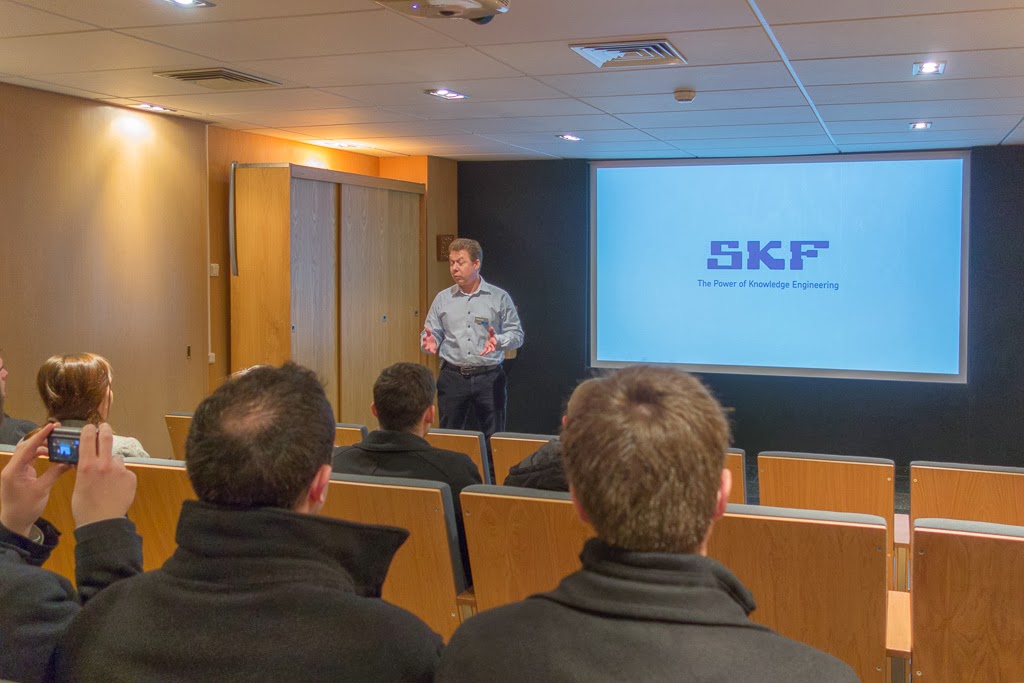
What started with the invention of the self-aligning ball bearing more than 100 years ago has now developed into something much more. SKF currently offers a large number of products and solutions within several different areas, such as mechatronics, seals, lubrication systems, servicing and bearings. They are a company with one of the oldest patents and they have expanded on that original patent with new innovations. Actually, they don’t say they are a ball-bearing company, but a company of innovation.
SKF provided another learning experience of a manufacturing facility. This tour gave us a visual experience from how a brick of steel is transformed into a ball-bearing. It was especially exciting seeing the efficiencies that computing services and ABB robots have on the product development cycle.
SmartEye does not manufacture a product, but Magus Sjölin taught us about being a sales manager for a service provider. SmartEye provides the market with a real-time and completely non-invasive eye, eyelid and head tracking technology for a wide range of situations. This presentation went into great detail about the product.
We were able to retain information about the system they use to track the eye, implement the software, and marketing of the product. The biggest learning experience from this presentation is how to sell a product. Without actually presenting on selling, he illustrated the importance of enthusiasm, passion, and courage when presenting a new technology. By this demonstration, he illustrated the importance of believing 100% of vision for your company.
In addition, he taught us the possibilities of technology. This is a relatively new business with a product that has not been established yet in the market. It has strong potential for growth and could transform the way we travel and advertise forever. The research and data analysis that can be gathered from this company is endless and I am curious to see where this company will be in 5 years, 10 years, and then 20 years.
The next study provided us with the experience of learning what it means to be a product development director. Per Norleen is the product development director at Getinge; a global medical technology company that provides equipment and systems within healthcare and life sciences. His role requires creativity, hard work, strong observation skills, and the ability to understand workflow interviews and identify bottle neck problems.
He taught us something that I have believed for a while. College provides us with knowledge, but real life and the business world provides us with wisdom. It strives to have a high retention of information and learn how to solve problems. Nevertheless, as Per said, “I haven’t touched tough math in a long time, but if you work hard, you can, and will understand it. If you work hard, anything is possible.” College gives us the tools for reading, writing, business, and conceptual thinking; but, it does not teach us that the road to success is not straight forward. It does not teach us that a four year degree does not guarantee a job. There will be plans and hopes and some will fall and some will raise, but wisdom will teach you how to rise from adversity and enjoy success.
Then, he went into more of the challenges of his role. He talked about customer value, internal value, innovation, organization, and time to market. To produce a great product, there are four steps one should take.
1. User Study
a. The explanation of observed phenomena of information use or expressed need
b. The prediction of instances of information uses
c. The control and thereby improvement of the utilization of information manipulation of essential conditions
2. Work flow analysis
a. Employees whose everyday role includes the processing, handling, and sharing of documents
b. Experts with a vision of how the work should be done
c. IT staff with an understanding about how the vision could be translated into a realistic solution
d. A facilitator whose role it is to manage the project and keep to specified limits in time and expenditure.
3. Case Study Scenarios
a. Produce the product on paper and question what images will do
b. Ex. What does this button do?
c. Analyze results and improve efficiencies
4. User design validation observations
a. Walkthrough of the product
b. Think-out-loud analysis
Per then went into the details of producing a product on a global scale. For example, in Germany, certain products need to be assembled because they want a certain response to appear when the product is used. While in Japan, they prefer for the product to guide them through the service the application provided.
“You need people to do work that they believe in. The executives are the super heroes, but they do not know everything.” Per believes that if you see an opportunity, you must go after it, even if it is skunk work.
To be successful in skunk work, you have to have a strong vision and the ability to form a team. At some points in the development of the vision, you may have to replace members and have the courage to do so. In addition, communication must be transparent and done constantly and well. Then, you have to be able to sell this vision internally, which is much harder than selling to customers. Unlike customers, internal people think they know what is best for the business, are more conservative, and avoid change. Nevertheless, if your vision is strong enough, then you can overcome those challenges and produce a great product.
He concluded his presentation with some personal wisdom. You must take initiative, and have the drive to want something more. Most importantly, you must have great relationship management skills. Personality is more important than education when everybody is on a similar education level because whatever you’re doing, you will always be interacting with people. If you want to succeed, you have to want to work hard and have good chemistry with your team.
In addition, he taught us the tools we need to be successful. You have to have the drive to achieve things and accomplish things. You have to have the ability to influence people and the power to drive those around you. In addition, you need to enjoy building new things and have a constant drive for something new. You have to be structured and organized and the ability to implement old processes and concepts and evolve them into new ideas and projects. Most importantly though, you have to enjoy what you are doing and have fun.
Pär Svensson is a project manager and PR missionary at Stylt Trampoli and he is a living example of what success is. Stylt Trampoli is a design agency and architecture company that has competency in advertising and business development, web development, and furniture art. They mostly operate in the hospitality experience industry.
They believe they know how to develop and bring things together and their process consists of developing a story, the designing process, and the success of their project. For the restaurant industry, it is crucial to change the style of the restaurant every five years. However, once you have a story, you can produce a quality story around it that can easily be manipulated to change.
Pär said, “It’s hard to ask somebody about an experience that they haven’t had yet. You have to just show them.” Through the marketing mix or four P’s (Product, Price, Place, and Promotion Differentiation), they can satisfy the Simon Sinek’s Golden circle and understand what consumers are most interested in their product. For their end product, the smile produced must be greater than the price for the product to initiate growth.
Their operations start with concept development from scratch and then they create an outline for the brand: names, product invention, trademarks, etc. Then, they design the idea and implement the product. Lastly, they produce the product and execute it within the market. The development of the full concept of a project takes about 6-9 months, but can generate great growth above the markets average profits.
This company taught us the importance of innovation and brand recognition. They strive to create products that are innovative and unlike any other product on the market through the interior design and storytelling. A great example is the Jay Fu’s Amasian Steakhouse that created a false story to create an adventure for the consumer. It made going to the restaurant a greater experience than just going to a traditional steakhouse and brought in more customers who wanted to see this unique restaurant.
By visiting the eleven companies on the trip, we were able to learn a diverse amount of knowledge. By the end of the trip, one aspect that was different from American business practices is the ability to transition a company description to a story. Numerous presenters gave great details about their business and supplied a product description that read more like a novel than a cut and dry description. Their interactive presentations were more engaging and brought more enthusiasm towards their products.
The business aspect of the trip was highly informative and a great experience and I will transition the knowledge I ascertained from the trip into my career. My perspectives on business are relatively the same; however, it became apparent that American business is more political as Swedish business is more about competency. They strive for equality, but all salary raises are based solely on performance, not who you know. That was one aspect I enjoyed about Sweden.
In addition, the work environment was more collaborative versus personal gains. The Swedish people would work together and transfer information freely where in America there is a tendency to hold information that could have personal benefits. Business seemed more innovative, yet we are more creative in the United States. They are more humble in Sweden and believe in equality over capitalism. Those are just a few comparisons that were noted throughout the trip. Lastly, they are more receptive towards friendships and have few close friends versus numerous friends.
In just two short weeks, I have acquired my MBA, JD, Ph.D in numerous studies, and ascertained material from a graduate level of study. Meeting with these companies has given me an experience that I otherwise would never have been able to have and it has forever changed my understanding of business, and the Swedish culture. “The world is a book and those who do not travel read only one page.” – Augustine of Hippo.